

Think of this as Volume 16, Number 38 of A-Clue.com, the online newsletter I've written since 1997. Enjoy.
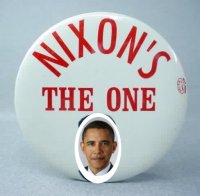 The election after a crisis is a key
tipping point for every generation.
A new set of assumptions, a political
Thesis with a Myth and Values seeking Power, is uniquely vulnerable
at this time. Because it's seeking validation for the very first
time.
In 1972 Richard Nixon knew this, and he
gamed the Democratic Party's nomination process to get the opponent
he wanted. He let his paranoia rule him, he was destroyed by that
paranoia, but the more important point is that the new assumptions
held.
Not just in 1972, but throughout the period of Republican Party
ascendency that followed.
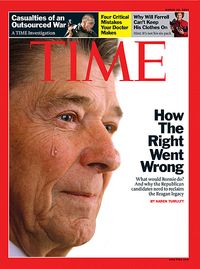 We know this because Ronald Reagan won.
His GOP moved away from the center, toward the right, after Gerald
Ford's version lost. Reagan won resoundingly, and Republicans were
dominant for almost 30 more years. That's what I mean by a "generational thesis" — the Reagan myth, the Reagan values, could be invoked by the Bush family to retain power for 20 more years, and Congress usually followed.
I've written about what I call the Nixon Thesis of
Conflict, which Reaganism validated, before. We are surrounded by
enemies that must be defeated. They have allies within our own
country. Our political opponents are allied with those enemies. These
political enemies are thus our country's enemies, they are
illegitimate. They must not be allowed in power.
Compare this with the Roosevelt Thesis
of Unity, which reached its end in 1968, yet which George McGovern
still believed in, thoroughly, in 1972. We're all in this together. Every
voice has value. Everyone deserves a living income. These assumptions
were obsolete in a world where energy had become the currency, and
where energy was becoming increasingly scarce, increasingly valuable.
I've also said before that politics
lags economics, that the needs of business have always dominated
American politics, even when business was against the new. The
Roosevelt era was dominated by manufacturing. The Nixon era has been
dominated by offices, by technology and content. But both eras rode
on energy as their currency – cheap energy in the Roosevelt era,
dear energy in the Nixon era.
Which brings us to 2012. The Nixon
Thesis is now 44 years old. Listen to Republican arguments in Tampa
and you would think this President were McGovern himself. It's an
obsolete caricature.
 But then peer behind the curtain and
what do you see? I see oil money. I see billionaires who are
fully-invested in maintaining a high price for the oil and gas
remaining in the ground. And I see a lot of desperation.
The key economic issue of our time is
energy. Global politics are defined by it. And only one party is
promising to fight the oil power, even half-heartedly. That's the
President's party. Republicans promise to put government squarely
behind more oil drilling at the expense of solar energy, wind energy,
biomass and tidal energy. They deny the reality of global warming,
even while it withers our crops and burns away our ice caps.
It's what is behind the crazy that you
should focus on, the Koch Brothers and their ilk. The neocons who
tied American foreign policy to maintaining access to Middle East
oil, even at the expense of our young heroes' lives. The social
conservatives who claim to oppose Islam, but in fact have made their
Christianity into its mirror image. The economic conservatives
convinced the world will come to an end if some creditors have to
take it in the neck – creditors whose assets are denominated in
barrels of oil.
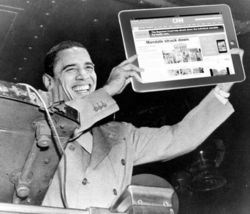 What I most like about this President
is how he seems to intuit all of this. He did not try to manipulate
the Republican primary. He accepted the 2012 version of Ed Muskie,
rather than insisting on a second-tier McGovern candidate. He doesn't
even mind being outspent, instead focusing on cloud technology and
grassroots organizing, even in the face of Republican efforts to
re-write the rules of election and bring back the poll tax.
Rather than confront Republicans
directly in Charlotte, as Bill Clinton (whose Third Way anti-thesis
to the Nixon Thesis is the basis for the Obama Thesis of Consensus,
just as Lincoln followed Clay and FDR followed Wilson) did, Obama
calmly laid out the values underlying his program, summing up his
“attack” on the oilagarchs with one word – citizenship.
Suddenly Muskie became McGovern. The
GOP had nominated a candidate with large accounts in the Cayman
Islands and other tax havens, one whose definition of citizenship
went in only one way – his own – and who was completely opaque
concerning his past and his plans for the country.
I think this was the turning point in
the whole campaign.
Since then the Romney campaign has been
flailing, their Jim Crow campaign against voter participation is
being seen for what it is, their embrace of a neocon foreign policy
obvious in reaction from Libya, their social policy is going on the
down-low rather than being embraced, as Todd Akin learned.
All these elements of the Nixon Thesis
were designed originally to create a “them” that the thin
majority of “us” would have a knee-jerk reaction against. But
what happens when “they” become the majority, and your side the
minority? What happens when “they” become organized, when “they”
have a more attractive candidate, with a more attractive platform,
when “they” become the future and you increasingly look like the
past?
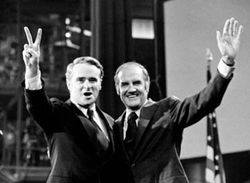 That's what was happening to Democrats
in 1972, and I can tell you from my life experience it sucked.
Watching reporters, women, blacks, academics, drug users, union
members and even “liberal” Republicans like Rockefeller be
demonized in their turn, and new groups thrown on the fire whenever
the fire threatened to turn cold (gays, feminists, environmentalists)
was a terrible thing to live through, and those politics defined most
of my life.
Most, but not all. Because we do have a
solution, finally, to the energy crisis. The Sun shines, the wind
blows, the tides roll, and we live on a molten rock. Abundance is
coming, we can see crossover through the window of our car as we
travel through time.
Everything is ready to be turned on its
head. The gating factor in our economy is moving from energy to
trained minds and willing hands. That's the new Thesis, an economy
built to last on innovation and education, an economy that grows out
of labs rather than office towers, that builds value rather than
manipulating it.
All that remains is to validate that
Thesis, to validate those assumptions, to convince the media that the
new majority can survive anything the minority can throw at it.
Vote.







link building strategies 2011
Dana Blankenhorn: Why Romney Lost
true assurance credit
Dana Blankenhorn: Why Romney Lost
earn online
Dana Blankenhorn: Why Romney Lost
Some say that Romney’s defeat is a manifest of the changing times where traditional Republican bailwicks are melting as America’s white population will be overrun by more diverse race immigrants. Also, Romney’s economic plans seem unrealistic.
Some say that Romney’s defeat is a manifest of the changing times where traditional Republican bailwicks are melting as America’s white population will be overrun by more diverse race immigrants. Also, Romney’s economic plans seem unrealistic.