

Good - Lower energy prices reduce the priority for alternatives, and the savings from conservation.
Bad - Energy has been lost among all the other priorities of the first 100 days.
You can't fight the market unless you either make it your top priority or have an ongoing market failure driving public opinion. We have ongoing market failures in the financial and health markets. But in energy, in the near term, the market is our friend. The recession has pushed oil prices into the $50/barrel range, and gasoline prices are half what they were at their peak.
It's also important to note who the enemies here are. There are two types:
Ideologues, mainly global warning deniars and conservatives who think anything a liberal suggests has to be wrong because liberals are evil; and
Industry types, moderates and even liberals who are interested in defending the business interests within their states or districts, and luring an industry's money into their re-election coffers.
This latter category can be hard to identify, because when an issue comes at them with enormous political momentum they are easily rolled, thus impossible to identify in the torrent of "aye" votes. It's when the priority declines, when an issue switches from being one of the masses to the upper classes, that these folks come out of the woodwork, sanctimoniously, and with their hands out.
Take Jay Rockefeller, for example. Should be a reliable vote for whatever's liberal. But West Virginia is a coal state, so not so much. The same holds for Bob Casey up in Pennsylvania, Max Baucus out in Montana and the new Colorado Senator, Michael Bennett. They won't stand up and shout "no," like the Republicans. But they won't do any work for you, either, and if the Majority Leader looks to get it onto the calendar, they'll privately go all-wobbly on cutting off debate.
The key bit of rhetoric used by the President in this legislative battle is "close the carbon pollution loophole." That's insider talk, not outsider talk. It sounds like he's talking about taxing something, or cutting someone's taxes. Most voters fall asleep just hearing such talk. Unless it's about them.
That's why I have pushed the frame of The War Against Oil. In that case we have enemies who are easy to identify, and easy to villify. All we need to do is link their interests to those of other suppliers, and point to the brake on growth their self-interest creates. It's in our national interest. It's national security.

Right now, any economic recovery will be crushed under the weight of the Oil Barons' self-interest. The more economic activity there is, the higher the price of energy. Until we break the link between oil and growth. Once that happens our growth can actually reduce their influence, around the world.
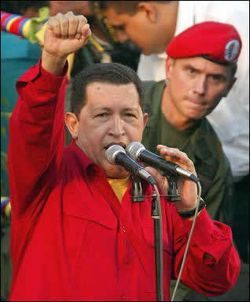
Or let me put it another way. You want to shut thugs like Hugo Chavez (above) up? Take away his stranglehold on our economy. Remove his hand from our throat by reducing demand for what he sells down to zero. On energy policy, with so much money at stake, it takes a consensus to make real change, and until we use the rhetoric of nationalism we won't have one.
But since the President is not making that case, the case is not being made. Until he does we will continue to have a big Obama Energy Fail.
TrackBack
TrackBack URL for this entry: http://www.typepad.com/services/trackback/6a00d83451da3169e20115705a0bf2970b
Good - Lower energy prices reduce the priority for alternatives, and the savings from conservation.
Bad - Energy has been lost among all the other priorities of the first 100 days.
You can't fight the market unless you either make it your top priority or have an ongoing market failure driving public opinion. We have ongoing market failures in the financial and health markets. But in energy, in the near term, the market is our friend. The recession has pushed oil prices into the $50/barrel range, and gasoline prices are half what they were at their peak.
Recent Comments
