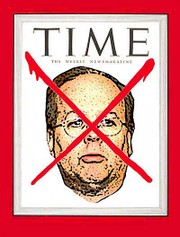
I have been writing what is turning
into an alternate history trilogy online for almost three years now.
It occurs to me that, when you read a new chapter in the latest book,
The Duke of Oil,
you may have no clear idea what you’re reading because you lack any
background in what has come before.
It is especially hard to follow since
the first two books were written while I was writing Mooreslore at
Corante and thus may be hard to find. Also, since many of the
characters are, in fact, real people, living real lives which have
nothing to do with my fiction, well the more explanation the better.
So for those new to my fiction, here is
a synopsis of the stories so far.

The Chinese Century, which was written
in a rush during the last two months of 2004, diverges from real
history soon after the 2004 U.S. election. A simple misunderstanding
between U.S. and Chinese negotiators leads the Chinese government to
let the Yuan float, and to sink the dollar by selling
dollar-denominated assets.
The immediate result is to end the
dollar’s status as a reserve currency, as Russia starts demanding
Euros for its oil
and other nations follow suit. It’s a full-fledged economic crisis,
which President George W. Bush handles very badly.

The hero of this book turns out to be
outgoing Chinese Premier Jiang Zemin,
whose mantra is a call for stability and military peace, against
which backdrop the Chinese economic miracle can continue. Jiang
undertakes a risky mission to Afghanistan, making himself a hostage
for the return of terrorist leader Osama bin Laden, who is sent to
Beijing to meet Bush. Bush’s reaction to seeing bin Laden may make
him a hero to some.
The practical result is quite
different. China achieves peace with Muslim militants
while the economic dislocations in America cause labor riots. China uses economic pressure to pull Taiwan more firmly into
its orbit.
As the economic dislocation within
America continues, the writer Dana Blankenhorn looks for a way out.
Unrest rises, and it rises further when the losers of the 2004
election, John Kerry and John Edwards, claim proof the election was
stolen. When millions appear outside his door to protest, President
Bush demands they be fired upon, destroying American democracy.
Chinese leaders take advantage of this
to make peace and isolate the U.S. further.
Economic power has done what military might could not.

Meanwhile, entrepreneur Richard Branson
has a plan. A new, computerized trading system, based in South
Africa, outside all government regulation.
He uses Sen. Kerry’s wife, Mozambique native Teresa Heinz Kerry, to get the deal done.
The new market will need trained
workers and Dr. Richard Florida knows where to get them, from among
the liberal creative class now being oppressed in the U.S.
Branson’s partner, Dallas Mavericks owner Mark Cuban, is among his
recruiters, and in Atlanta he chooses an official blogger.
Guess who?

The American Diaspora, written during
2005, is mainly set in South Africa, where the Virgin-Maverick
marketplace, staffed by former American liberals who have emigrated
in the face of dictatorship and economic disaster, work to build
something new on the southern edge of the Earth.
The central figure is Dana Blankenhorn,
hired as a blogger and journalist, who transforms himself during the
course of the book into an entrepreneur and public figure under the
tutelege of Richard Branson.
The background consists of real events
of 2005, including the East Asian tsunami,
the re-election of Thabo Mbeki,
and the stem cell research debate.
Branson gives full support to The World
of Always On, a set of technology concept I had written about since
2003 on Mooreslore.
But my growing fame makes me a target, and much of the book has a
Perils of Pauline quality, with me as Pauline.
The economic and social crisis which
impacted the real South Africa in the real world is averted by the
money and earnestness of the new immigrants.
American attempts to slow this new economic rival radically change
the character of Cuban, who also emerges heroically.

Given that the centerpiece of this new
world is a replica of the Twin Towers, re-built in Johannesburg, it
was almost inevitable that a terrorist threat would be made against
it.
There is also an unlikely miracle, written during the Katrina
disaster.
Still, the result of all this is a new
world, in which the U.S. is a failed state and South Africa is a
successful one, in which I’m rich, famous but constantly beset with
the risk of possible death. The book ends with me again on
tenderhooks.
The Duke of Oil, which was begun early
in 2007 on www.danablankenhorn.com and is still in process, is a sequel to The Chinese Century
and The American Diaspora.

The centerpiece of the book is the
resignation of Vice President Dick Cheney and his move to Dubai,
where he is named to head an electronic market similar to the Virgin
Maverick company I created earlier in South Africa.
The Cheney of my book loves his family
but determined to become one of the richest in the world by allowing
wealth to trade regardless of provenance, with no income tax and the
full backing of the local Sheikh.
What is most amazing to me is how
prescient parts of all three books appear in August 2007. The idea of
private, unregulated markets, the threat of economic pain caused by
China’s American investments, are both realities in the actual
world. How they will play out is anyone’s guess. We’ll see where
the adventure leads in my alternate universe.
In order to get on with the plot I have
to tie up some loose ends, including the fact that Cheney was reported to have died in The
Chinese Century.
Our fictional Cheney’s plans move ahead rapidly
and are quickly seen as a serious threat.

Given that the real Richard Branson was
profiled in The New Yorker as having a keen interest in alternate
fuels,
I decide to create a parallel plot. Branson and I are going to work
hard on alternate forms of energy, specifically solar power and
hydrogen, with the aim of cutting demand for hydrocarbons and cutting
off Cheney’s wealth in that way.
After watching the movie The Pursuit of Happyness I decide to make its hero, Chris
Gardner, a hero in this book, replacing me as Branson’s partner in
the new venture.