Unfortunately there's a sort of rough justice which takes place during these market crashes. I have seen it during every single crash I've ever covered, from the oil crash of 1981 through the dot-bomb of 2001 through today.
We don't want idiots bailed-out. Those of us with cash, or those who stayed on the sidelines, want the chance to pick through the wreckage at our leisure. Analysts claim there are two emotions, fear and greed, which determine where prices will go. There's really only greed and greed.
During a boom everyone wants to be venture capitalists.
During a bust everyone wants to be vulture capitalists.
It's in the nature of a crisis that it shifts the terms of political debate, like the tacking of a sailboat.
Debate will then follow the new course until a new crisis for which the previous course has no meaning is reached.
When the ship of state tacks, of course, all hands who've lived on the old course are completely at sea. They can't conceive of a shift in course, and start crying like scalded cats. That's what you're seeing now, in the Washington Village, in the media which covers it, and among the groups nurtured by the followers of the old course.
The old course has become so ingrained in the minds of the lazy that they have created terms to describe the course to make it all sound scientific. One such bit of nonsense is the Overton Window.
While unregulated financial markets are a big problem, they are not the entire problem with the U.S. economy.
Or the world economy, for that matter.
The problem for the world economy is a shortage of clean energy, a crying shortage of clean energy which has been 30 years in the making. All our incentives have favored hydrocarbons, and alternatives have been given no fair chance.
Whoever finds a way to supply this demand will get very, very rich. So the whole trick of the next few years must be to re-orient our government's financial incentives in favor of this new supply, and against older, unstable supplies.
In The Answer to All Fears I describe the economic process which must be set in motion, but below I'm going to give you the whole key to the thing.
Earth to journalism. Dr. Ajayan (Banaras Hindu University '85 -- go BHU) and his team were not looking for something new for Kate Moss might wear on a runway, or for Britney to put on for the Brad Renfro funeral. (Although going there might sober her up.)
This is serious science, with serious implications.
Think of this as Volume 11, Number 3 of A-Clue.com, the online newsletter I've written since 1997. Enjoy.
I'm going to sound a little like George W. Bush here.
But there is a one size fits all solution to all our basic problems.
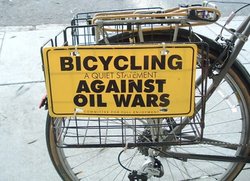
That solution is The War Against Oil. (Image from Bikecommutertips.)
To fight a War Against Oil means to make this your main priority, and to subordinate all other policies to it. It doesn't just mean throwing a few subsidies to well-connected ethanol growers. It means making certain the market will accept any alternative energy coming in at a decent price, and tilting your market with taxes so that it favors cleaner sources over dirty ones. It means highlighting solutions in all public appearances, and making it the centerpiece of your rhetoric.
Unlike Bush's one size fits all solution (tax cuts for rich frat boys) The War Against Oil actually works.
The War Against Oil is foreign policy, because it makes us more energy independent and reduces the power of our oil-exporting adversaries.
The War Against Oil is terror policy, because the new forms of energy can be dispersed, as you will see.
The War Against Oil is environmental policy, because clean energy means reducing the use of hydrocarbons.
The War Against Oil is technology policy, creating new jobs through new research.
The War Against Oil is education policy, since the required knowledge cuts across so many disciplines.
Perhaps most important, the War Against Oil is economic policy.
The War Against Oil is the issue on which to center our new political Thesis, that of the Internet, and that finding is justified by the history our chattering classes are now so intent upon.
There's a simple way Barack Obama can take this campaign by the scruff of the neck and do something marvelous at the same time.
Go to Kenya. Or at least promise to go to Kenya. Send Bill Richardson to Kenya, as a personal emissary, and offer to meet the two disputants to sign a settlement of their dispute.
Barack Obama has the same interest in Kenya as Bill Clinton had in Ireland, when he offered help in that dispute. Moreover, Obama's paternal grandmother still lives there. And the dispute is similar, with tribes substituting for religious groups. A civil war is raging, and it must be stopped.
There's another reason to get into the middle of this, which is to illustrate the damage the Bush Junta has done to America's cause. Since the Supreme Court selection of 2000's loser, we've seen repeated examples of contempt for democratic process, when that process might result in a change of regime.
Listening to last night's Democratic debate with some knowledge of history, it was pretty easy to see how far-right the Nixon Thesis has taken us in the last 40 years.
Ideas that were once common kant have become heretical, even on what's supposed to be the "left."
Let's start with the economy, stupid.
It's the Administration's Class War and its Robin Leach tax policy (while accusing Democrats of being Robin Hood), that has gotten us into this mess. Giving business everything it wants delivers no more discipline than allowing a child all the candy and ice cream it wants.
Yet rather than couch a firm program of business reform and tax fairness as the pro-competitive measures they really are, the Democrats acted like their far more-modest proposals were socialism in our time. It's like they've despaired of winning any business support, except for class traitors like Warren Buffett, and that unalloyed feudalism represents some sort of rational moral universe.
The most craven example was on the subject of bankruptcy. The 2005 bill was simply called "unfair" to homeowners, rather than what it really is -- bad business. When a credit card debt is not discharged in bankruptcy, it remains a non-preforming asset on the bank's books. That means the bank can't make new loans, and the debtor can't take new borrowings from anyone. Both sides are frozen. If that debt can be written off the bank is now free to make new loans and the debtor, while relieved, should have that mark on his ledger so other banks will be more careful.
Yet there were no economic arguments offered.
John Edwards is under the mistaken impression that universal health care, a higher minimum wage, and education aid represent class warfare against the rich. Universal health care cuts the bills for those enterprises which offer insurance, a higher minimum wage assures more consumer demand for what businesses produce, and a better-educated work force is what businesses need to compete.
The whole economic argument of the Democratic Party seems to be based on equality, when it should be based on growth. Even the idea of a progressive income tax can't be seriously taken up any more -- we're just trying to get Warren Buffett's rate up to the level of his secretary's! All business interests have been ceded to a party which has led them onto the rocks, through a program which rewarded dishonest practices and hurt honest dealing. Honest businesspeople have no party any more.
But it was on the social issues where I really got mad. (You may get mad in response. Fair warning.)
One way in which the Internet can impact policy in the coming years is by speeding the flow of information and belief from the people to policy-makers.
In the TV age there can be immediate reaction, but only to one thing at a time. Subjects beyond what appear on the nightly newscasts are usually dealt with through elite interaction, which occurs more slowly and can become dominated by specific business interests (as opposed to the interest of business generally).
With the Internet, on the other hand, everything can be on the table, at all times. When views change, not just among elites but among the people generally, the Internet enables this to be reflected back to policy makers, even on subjects previously left exclusively to elite lobbyists.
A great example of what I'm talking about here is The War Against Oil. Everyone agrees on the priority. Even Republican candidates in 2008 accept the premise of global warming. But throughout the political class there's a disconnect between what they're chattering about and what's happening here on the ground.
The answer is, much worse. As with Texas a generation ago, America is about to lose its banks, with foreign operators coming in to take over. We are about to lose our financial sovereignty.
This will make it harder than ever to get America back on its feet after the coming recession. In the past, you just reflated the economy by pushing out new money. With no one wanting the new money, with the dollar already tanking before the recession starts, this solution becomes ridiculous, just as it has long been ridiculous throughout Latin America.
When Brazil or Argentina lets the books go out of balance, the currency is no get-out-of-jail-free card. The answer recommended by American bankers is to link their currency to ours, to fix an exchange rate which will enforce fiscal discipline. This delivers short-term stability, while drastically lowering local living standards, and in the long run it's asinine. I can't wait to read the Heritage Foundation press release first time someone suggests we tie the dollar to the Euro.
Think of this as Volume 11, Number 2 of A-Clue.com, the online newsletter I've written since 1997. Enjoy.
The difference among Democrats is subtle -- perhaps too subtle for TV to catch.
But it's there.
I've compared Hillary Clinton to Richard Nixon before, the key to that comparison being her role in the AntiThesis to Nixon's Thesis, which still governs America in 2008, and the ruthlessness which many Democrats, as a result, see as her strength. I've also talked about Barack Obama's comparison to Reagan and my love for John Edwards.
Edwards' star is fading fast, unfortunately. His populism is drawing people like me, those accused of wealth and guilty of education, but failing among its target audience, those with lower-middle incomes. Democrats in that group are going to Clinton, while Huckabee does well if they're Republican. Edwards is left with the "limousine liberals," those who know history. I have compared him here to FDR and to those of lower income that's all FDR is -- history.
What the media does -- and it wants to do this at an accelerating pace regardless of who it hurts -- is winnow down the field quickly. It does this with the early primaries. Single digits in Iowa and you're out. And after New Hampshire they want a two-man game in each party. Thus Fred Thompson and Giuliani have been dismissed, with Romney given the task of "Michigan-or-bust." And on the Democratic side, Edwards is considered gone.
We're left with Obama and Clinton, and the real issue, which is similar to what Republicans faced early in the last generation when the battle was between Reagan and Gerald Ford.
That is a choice between the new values and the old interest groups.
Recent Comments