With the sudden return to warm (air conditioner warm) temperatures in the Southeast, we enter the Summer of '07.
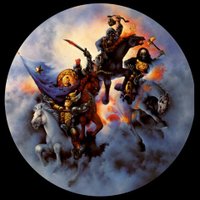
It's a scary time. Just like the Summer of '67 was a scary time for the suburban homeowners who went through it. Or the Summer of '31 was for the farmers and workers who went through that. (Images from Kirwanesque.)
As we approach a generational crisis, the summer before the crisis election comes to take on a haunted quality. Its events tend to represent the whole of the excess which led up to it. In the initial crisis election, it is the events of this summer that are rejected. Later, as the new Thesis runs its course, it will be the whole decade, all its cheerleaders, and all their followers who will be rejected.
It's silly to talk about what we can expect from this summer, because at the heart of these events will be the unexpected. But here is what we know is coming:
Following is the essay you can designate as Volume 10, Number 13 of
This Week's Clue, based on the e-mail newsletter I have produced since
March, 1997. Enjoy.
The forces which have risen to power
in the United States during this decade are identical to those which held Latin
America in bondage for most of its history. (The picture is of the Simon Bolivar statue in Central Park, NY. Bolivar's dream of a free, democratic, and united Latin America has been systematically ignored in the 200 years since he rode.)
Those forces represent an Iron Triangle that has strangled the continent. They are Army, Church and Oligarchy.
For 200 years, Latin democracy has been a sometime thing, as military juntas held a veto on what governments could do. For 200 years the Roman Catholic church has controlled political forces dedicated to keeping the poor barefoot and pregnant in the name of an autocratic, all-male hierarchy. For 200 years economic oligarchs have held all those nations' assets to themselves, preventing social mobility from raising the worthy or pushing down the unworthy.
Now this political model has been imported to the United States of America.
These forces were held out of power here for two centuries, not
just by a Constitution based on checks and balances, but by traditions begun by
our Founders and honored through the development of the Nixon Thesis, which has dominated this nation's politics since 1968.
It was the Nixon
Thesis' dependence on narrow majorities, and its need to be constantly renewed
through the creation of new enemies, that made the system uniquely vulnerable to
attack, and which could yet destroy it.
With those simple, true words, Elizabeth Edwards transformed the campaign of her husband into a crusade.
John Edwards has talked about the "Two Americas" for over three years now, the wealthy one where he lives, the struggling one where most other people live. Those two words of Elizabeth brought it home, because they are so very true. Elizabeth Edwards is very lucky. She has the best possible doctors, and her husband has enough money so that she doesn't need to worry about paying for her care, or bankrupting her children for her care, or cutting off her care to avoid financial ruin.
Most of us aren't so lucky. Millions of Americans face bankruptcy with far-simpler diagnoses than she got this week, a metastasized breast cancer that has spread to her bones and lungs, inoperable, incurable but (for now) treatable. Americans pay more per capita for health care than any other people in the world, and get less for it.
Yet this is just one of several crushing problems our middle class faces. The sub-prime loan scandal is becoming a crisis. What Lou Dobbs calls "The War on the Middle Class" is real.
Google is an agent for the buyer of information. In a world of unlimited information, this is where the value is. (T-shirt available here.)
TV networks and movie studios are, when they distribute video, agents of the seller. In fact, they usually are the seller. (Movie studios increasingly distribute films for others.)
The NBC-Fox announcement is predicated on the idea that their video is unique, must-have stuff that can't be replicated. It is also predicated on the relationships the networks who produce the video have with advertisers, who will be called upon to support the video.
You've read enough psychoanalysis, and enough news coverage, and enough blah-blah-blah on Al Gore's testimony yesterday to last you many, many weeks.
I just want to go back to one point Gore himself went back to, again-and-again, often in response to questions, usually unbidden.
The ElectricNet.
The concept is simple. The current electric power system is based on one-way traffic, on big plants sending power long distances and customers buying it. An ElectricNet is two-way. You can sell power back to the power company, at the market price, if you are producing more than you are using at any particular time.
The idea is that homes and businesses will soon be sporting solar panels and windmilling propellers, so that on temperate days, or when they're out, they will be producing more power than they can use. If you can sell this power back, there's an incentive for people to do more of this. Just as vital, you can cut the distance power must travel between producer and consumer -- you lose less.
Getting from here to there is a massive undertaking. It requires that the whole electric grid be re-architected. This will cost a lot of money. If you mandate that the money be spent, and account for it in rates, then everyone's rates go up. I believe that our electrical grid has to undergo fundamental change anyway -- we need to install better conductors so they lose less of the power they produce -- so some of these costs can be lumped into it.
I have always had a soft spot for Al Gore because in our hearts we're passionate about the same thing. Journalism.
Unlike most journalists, of course, Gore was pulled by a family obligation into another direction, into politics. His 1970 Vietnam service was heavily publicized, in an effort to get his father re-elected to the Senate. It didn't work. This made him the carrier of the family flag, and he took it as far as he could go, but with the 2000 debacle, and the death of his parents, the obligation is finally discharged. And Al Gore Jr. could go back to being what he really wanted to be all along.
Gore has been a journalist all his life. He went to Vietnam as a journalist. He studied journalism at Vanderbilt and then went to the Nashville Tennessean. As a Congressman and Senator he worked mainly as a journalist -- gathering facts and finding recognizable stories in them.
While many journalists, myself included, move from story-to-story, however, Gore has always gone back to one story. Global warming. It was at the heart of his best Senate speeches, it was at the heart of his two Presidential campaigns, it was the center of his work with President Clinton. And when the 2000 election was stolen from him -- yes, stolen -- he went back to his first love, to his story. He learned to tell it so he could do it in his sleep, and he stayed on the beat, adding new information all the time. Given his prominence he was able to get the best sources.
The current housing bubble, now in the process of popping, is the biggest con in the history of finance. The Wall Street Journal, politicized economists like Arthur Laffer and Larry Kudlow, and (in general) the Republican Party have created an enormous asset bubble, but they are even now in the process of deflecting blame, claiming it was regulation (rather than de-regulation) which caused the crash.
The Bush Disaster is a three-legged stool. The so-called neo-conservatives who got us into Iraq and who represent military contractors and oil field services outfits such as Halliburton are one leg of the stool. The Religious Right, which seeks to remake the U.S. into a Christian Iran, is the second (the weakest, most public) leg. But it is the third leg, the Wall Street Kleptocrats, who are the stiffest, most important, largest, and most criminal leg.
They can subpoena those officials, but the President will resist. Congress can pass a resolution declaring these officials to be in contempt of Congress. And you know who is supposed to enforce that? A U.S. Attorney appointed by President Bush. That's called a conflict of interest.
It is the third in a series of sci-fi novels of the type known as
alternate history. What's different is that this series takes place in
our time, with characters familiar in your real life.
Once we have a few chapters set up, I'll create a table of contents for the book and keep it near each chapter as it is written.
Meanwhile, settle down and relax. Any similarity between the
characters in this book and real people is purely coincidental, purely
a product of imagination, and not meant as real in any way.
Fact is, I underestimated the pace of change, which I don't usually do. I assumed the 2008 campaign would require an intimate, interactive relationship with the candidate, which the 2004 Dean campaign had.
Since then, Internet politics has advanced by leaps and bounds. The 2006 Had Enough ads, produced with help from Hollywood music mogul (and blogger) Howie Klein, gave many candidates an even-shot where they were being outspent heavily. The Macaca Incident took down George F. Allen, putting him on the defensive from the moment the video hit YouTube.
But do you really need a heavy-hitter like Klein? The 1984 mash-up (above) cost Obama nothing. It has been viewed 1.3 million times by last count, gaining precious media buzz. Obama is already drawing immense crowds, thanks in part to self-organizing at Facebook and MySpace. It took Dean months to understand self-organizing. Obama's campaign has understood it from the start.
The intimacy we seek in 2007 is not with the candidate, but with the process.What Obama has done is to give tools to people who weren't familiar with them. The Hillary mash-up is just the first shot in what will be a long media war fought between the Internet and TV.
In this case, notice that the ad sat virtually unnoticed for some weeks before political bloggers picked it up. They passed it along to newspapers, and from there the story went to TV, where the candidate himself was asked about it Monday. The good news is that Obama was by then familiar with the video, and knew exactly what to say:
"In some ways, it's the democratization of the campaign process, but it's
not something that we had anything to do with or were aware of and that,
frankly, given what it looks like, we don't have the technical capacity to
create something like this. It's pretty extraordinary."
Notice all the things Obama did in that paragraph. He denied responsibility for the ad, he put the ad into historical context, and he praised the ad, increasing the buzz. (Mama didn't raise no dummy.) The whole process cost his campaign absolutely nothing.
Recent Comments