Think of this as Volume 16, Number 42 of A-Clue.com, the online newsletter I've written since 1997. Enjoy.
 Win
Win
or lose in November, Barack Obama has been the Greatest President of
my lifetime. Or yours.
He
has the class of a great entertainer and lives his values more
completely than most religious leaders. He can seem introspective and
cold, but so have all America's greatest leaders. He writes in a way
that makes you cry. He inspires but can laugh at himself. We are
lucky to have him.
There's
a scene in “Guess Who's Coming to Dinner,” the 1967 Spencer Tracy
vehicle, that always makes me cry these days. Sidney Poitier, playing a version
of his “magic Negro” character from the period, wants to marry
Tracy's daughter, played by Katherine Houghton (Hepburn's niece).
They met, yes, in Hawaii. Tracy has just told him about the
discrimination they'll face, that their child will face. “She wants
him to grow up to be President,” says Poitier, “but I'd settle
for Secretary of State.”
 Barack
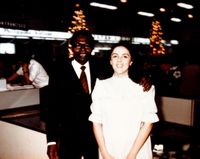
Obama's father was not a Magic Negro. He was a brilliant, tortured
man who became an alcoholic, a Kenyan who would never get a shot at the power he sought
back home due to tribal discrimination and the fact that, in Hawaii,
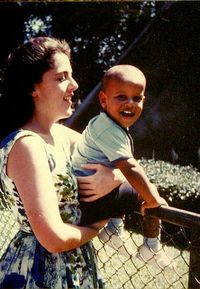
he fell in love and briefly married a white woman named Stanley Ann
Dunham. “Mine is a story that could only happen in America,” the
son says, and that was truer than anyone would admit.
In
conventional terms, Barack Obama was totally unqualified for the
office he sought in 2008. He had only been in the Senate for a few
years, and had only one memorable speech to his name. His Illinois
career had been lackluster, and he'd failed to win a race for
Congress in 2000 because he wasn't “black” enough.
 But
But
he was, and is, a man for his time. His oratorical gifts are
unmatched for his time, and his skill as a writer – both his books
were best-sellers – had already made him a small fortune by 2007.
Financially, however, he may be the least wealthy President we've had
since Truman. By the standards of conventional politics he's a poor
man, although he constantly points to himself as wealthy, when he's
trying to make a political point.
I
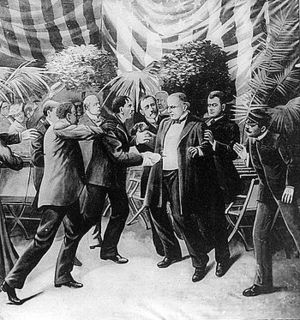
have written before that America had four existential crises in its
history, before the 2008 collapse. The first was in 1860, when the
union itself was threatened. The second was in 1896, when the economy
was on the brink of greatness or dissolution. The third came in 1932,
another economic crisis, and the fourth came in 1968, a generational
civil war sparked by Vietnam.
Each
crisis gave us a similar type of leader. What Abraham Lincoln,
William McKinley, Franklin Roosevelt and Richard Nixon had in common
was that they were less than their supporters wanted them to be, that
they were products of opposition to a dominating Thesis of the
previous generation, that they had supported its Anti-Thesis, which
had flowered briefly and then been blown away by events. Lincoln
followed Clay, McKinley followed the Mugwumps and other Republican
reformers, Roosevelt followed Wilson and Nixon was Eisenhower's VP.
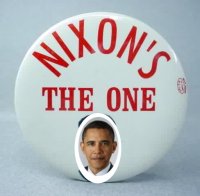 Similarly,
Barack Obama's politics are to the right of what his supporters want,
and stem from the Clinton Anti-Thesis to Nixon's assumptions. Clinton
was a “yeah-but” President, a man who tried to moderate the Nixon
era's demands on social, economic and foreign policy issues, and who
used Nixon-like rhetoric to suggest that Nixon's opponents had
learned some things, accepted some assumptions, but could simply
manage things better.
Upon
seeing just how bad the situation was during the campaign, Obama
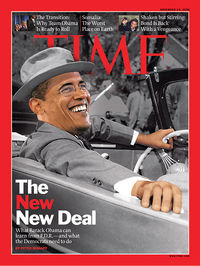
modeled his cabinet on those of Lincoln and FDR, appointing a serious
rival as his Secretary of State, and seeking other cabinet members
from the GOP. He also brought in technocrats, like Stephen Chu,
people with real expertise in the problems they were dealing with.
And then he generally left them alone.
Meanwhile,
he played the hand he was dealt without complaint. The Bush people
lied about how bad the situation was in late November 2008, so the
stimulus he suggested was too small, but he has yet to even
acknowledge that. He saw that Republicans were as obstinate as
Confederates in opposing him, yet he somehow got a health care reform
bill through the Congress. He was hammered as badly as Harry Truman
by the off-year elections, but he kept smiling, kept pushing for
bipartisanship, and acted on his own only after proving there was no
other way forward.
What
liberals (like me) hate about this President is that he's accepted
Bush-era premises on terrorism, on drone strikes, and in law
enforcement. But he has gotten more done, costing far fewer lives,
than his predecessor. Bin Laden isn't the only enemy of America who
is dead. So is Gaddafi. Chavez and Ahmadinejad are reeling. Even the
“false friends” of our recent past have been done away with,
Mubarak is gone and Assad is going. We've ended one war and committed
to ending the other. A peace dividend is on the way, if we just have
the courage to take it.
 Have
Have
liberals noticed that suddenly we're winning on the social issues,
and that things we couldn't talk about for years – abortion,
immigration, gay rights – we're now on the offensive on? Have we
noticed that Democrats are now supported by the people (if not by
Wall Street) on the issues of the economy, and deficits? Has anyone
noticed renewable energy doubling, and doubling again?
And
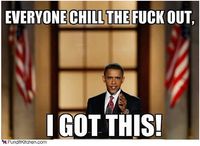
through it all he laughs. He actually laughs. Lincoln never laughed.
McKinley barely cracked a smile. FDR laughed, a little, but it was
usually for effect, a political laugh. (Don't get me started on
Nixon.) This guy laughs with a full heart, with a huge smile. Instead
of getting angry over his recent debate performance, he makes jokes
about it. He doesn't yell at his crowds, he engages in conversation.
Yes.
Barack Hussein Obama is our first African-American President. But
with another four years others may acknowledge something I've long
thought possible, that he's our best President. Period.