Think of this as Volume 16, Number 43 of A-Clue.com, the online newsletter I've written since 1997. Enjoy.
 The
The
most misunderstood President in American history was Willliam
McKinley. (Right, from Wikipedia.)
I'm
still reading crap about how conservative McKinley was. With hints
about his being corrupt.
Fact
is it was McKinley who launched the investigations that broke up
Standard Oil, it was McKinley who began the Progressive Era, and it
was McKinley who made Theodore Roosevelt the President by making him
Vice President.
The
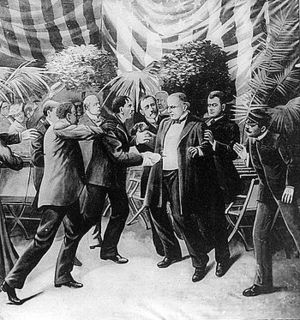
reason for the misunderstanding was McKinley's assassination, in
1901, at Buffalo, by an anarchist named Leon Czolgosz. (right.)
Reform is the enemy of
revolution, in that reform makes revolution unnecessary. The killing
froze McKinley within his time, and as the Republican Party moved to
the right, his memory moved right with it. It was Bryan's Populists
who were the racists, the states' rightists, and the conservative
force of that time.
Point
is, every crisis President is misunderstood, when seen within his own
time. And from both sides.
-
Lincoln
was seen as too conservative by radical Republicans, who impeached
his successor as a result. At the same time he was far more radical
than any southerner could accept. -
FDR
was seen as a communist by the far right of his time, while later
historians see him mainly as a moderate. -
Nixon
was seen as an arch-conservative by liberals in the 1970s, but in
retrospect may have been the most liberal President in American
history, creating a host of new agencies, opening the door to China,
and appointing Supreme Court justices like Harry Blackmun, who
authored Roe vs. Wade.
 The
The
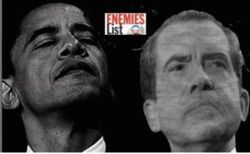
same is true today. Liberals see President Obama as an uncertain
trumpet, conservatives as the devil incarnate. He is neither. He is
simply a good man struggling to both deal with crises and push
through moderate reform, in an impatient time.
It
is because crisis Presidents are so misunderstood that their beliefs,
which I have called their new Thesis, the set of myths and values
that define their power, is at such risk in this particular point of
their presidencies. It's because the old order is fighting for its
life, throwing everything it has into it, while the new order stands
fearfully by, unsure of its own power.
 I
I
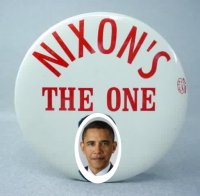
had the benefit of being a conservative in 1972, and I saw it from
the inside. There was an assumption among my friends that liberals
were still dominant. They controlled the Congress, they controlled
the media, they controlled the colleges, they had the young people.
We, the avatars of a new order based on suburban stability,
anti-communism, and privately-led change, felt beleaguered, under
assault, threatened from every side. Just because you're paranoid, as
Nixon was, doesn't mean they aren't out to get you, because they
were. And they did, once the results of Nixon's paranoia were proven.
McKinley
and Nixon stand as examples of what can happen when a crisis leader
falters, or is taken from the stage before his new assumptions have a
chance to take root. Both were replaced by history, by Theodore
Roosevelt in McKinley's case and by Ronald Reagan in Nixon's. But,
over time, the new assumptions held because new coalitions had been
established, a crucial segment of the population had changed its
mind, and because the new Thesis dealt effectively with the problems
of the day.
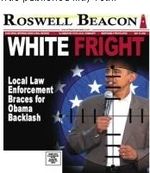 These
These
are the days that try the souls of President Obama's supporters,
because there seems to be so much uncertainty. We see polls pointing
to a Romney win and we panic. We feel beleaguered, surrounded. (Sound
familiar?) But the fact is that history is on our side, demographics
are on our side, the process of change this President began will not
be reversed, it will just take some amount of history to prove that
point.
All
of which leads to one final, and very sad, point, for all those who
believe in this President. As bad as this year may seem, as uncertain
as things may now appear, next year is likely to be an annus
horribilus.
Look
at the record of past crisis Presidents. What happened in the first year of their second terms? Lincoln and McKinley, dead.
FDR, lost power in the Court packing controversy and suffered a
second recession. Nixon, Watergate. Even Thomas Jefferson suffered
the uncertainty of the Barbary War and the Lewis and Clark expedition
in 1805, while Andrew Jackson suffered
through the South Carolina nullification crisis,
the first echo of what would become the War Between the States, in 1833. When you try to change
history, history fights back, and one man alone can't do the job.
 American
history doesn't move forward in a straight line. Historians, both
amateur and professional, look at the past for clues to the future,
but all we get is a clue. There is never certainty about today or
tomorrow. It is for us, the living, to fight our way through for the
future, knowing only that it's what our fathers, grandfathers and
forefathers did.
Just
remember the new thesis. We take care of our own, wherever this
flag's flown.
Don't lose that faith. Keep moving forward and fighting
for a better future. That's what makes you an American, the genius of
the past that lets you keep doing that, and will let you keep doing
that, for all your days on Earth.
The fight, not the victory, is your
birthright.