

Think of this as Volume 14, Number 23 of A-Clue.com, the online newsletter I've written since 1997. Enjoy.
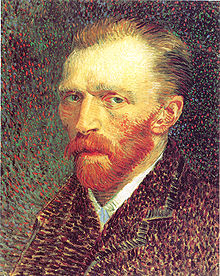 It is said that Vincent Van Gogh cut off his ear because he couldn't sell his stuff. And that he never did. (Image from Wikipedia.)
The great artists of the 20th century learned this lesson well. Picasso, Dali and Andy Warhol were all relentless self-promoters. They knew that art which isn't seen does not exist, and that an artist's personal style is what he sells during his lifetime.
Somehow, we've gone backward in the era of the Web.
The lesson of my run-in with Chris Buzelli and his friends is clear. No Web site can use a thumbnail of someone else's art without the artist's express permission. This is what artists say they want.
It's self-destructive.
Technically, this position even prevents links. If I write a piece of HTML code linking to a graphic image, and give the a href command properly, my browser will go to the location of that image and copy it, in the size I specify, onto the page I'm writing.
That's the way HTML works.
But to self-important artists if I write such a link I'm a thief. I'm a double thief, because I have not only stolen art but bandwidth to display it on my Web page. Thus you don't even link to art without permission.
What galls me is that artists believe they don't have to watermark, they don't have to use robots.txt, they can post their stuff completely in the clear. Ghanaians know to protect their images (try downloading an image from this page) but American artists can depend on webmobs.
The default with images is, don't touch, don't link. So we don't. I won't.
My purpose in writing today is not to litigate the question of legal right. Nor even the moral right to link. I won't link to anyone's copyrighted image henceforth, without a Creative Commons license or a Wikimedia address. Neither will anyone at CBS Inc., nor, I gather, any other media outlet.
Instead I'm arguing that forbidding links, or thumbnails, is counter-productive. It's as dumb as Nikkei forbidding links to its home page or the London Times charging for access.
It's as stupid as Van Gogh cutting off his ear.
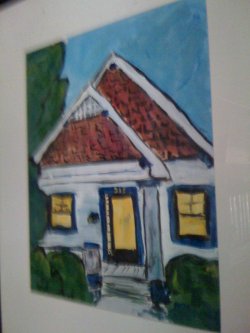 If I have learned one thing in my years online, and I've been online for over a quarter century, it's that a Web page that isn't seen does not exist. (Art by Roland Heath. From my wall. By permission of the artist.)
The Internet is all about links. Pages without links are cul de sacs. That's why, even if you're charging for site access, as The Wall Street Journal does, you want to leave some of your stuff out there, and publicize its existence far and wide. It's called selling. And if you don't sell you starve.
Well, artists can't sell. They have made all their sites into cul de sacs, by insisting on their legal rights. By doing so they have placed themselves at the mercy of lawyers and agents, of people who do not have their best interests at heart.
Oh, an artist's agent will claim to have those interests at heart. They will proclaim it far and wide. They will insist they are the only person in the world who can find their artists an audience. And because every Web site with a piece of art on it is a cul de sac, they're right.
The difference between these agents and Lou Pearlman is only one of degree. He took advantage of musicians who had no other outlet to the market. Artist agents and lawyers who reject links to art do the same thing.
But what does that mean in practical terms? It means that an artist can't have their work seen without going through an agent, and paying that agent whatever commission they demand. At least until they're selling well enough to get a better deal.
Because putting a "Creative Commons" license on a Web page won't get your stuff seen. People who create Web pages have learned, some the hard way, that you can't be certain. A license like the Creative Commons grant can be withdrawn. The artist or their agent may not like the "environment" in which their art is "displayed" some day, pull back the grant, and then demand that their art be taken down, ex post facto.
So we don't use it. No one uses it. Art that is protected by copyright does not exist on most of the Web, even though videos are common. Thanks to agents, lawyers, and web mobs .
Look, I'm in the copyright industry myself. I don't make a dime from this Web site. My only purpose in writing here is to convince editors that I'm worth hiring. But those editors, unlike artists' agents, are smart. They're active users of Search Engine Optimization, of social networks like Twitter, they use RSS feeds as much as they can. Because they want to sell their stuff. Which means doing everything they can, legally, to get it seen, not doing everything they can, legally, to keep it from being seen.
Chris Buzelli is a better artist than I am a writer. But I suspect I earn more than he does. There is a reason. Because my work is seen and his usually isn't.
I am not saying art has no monetary value. It's one of several lies artists have told, been told, and believed in the wake of what one editor recently called "DanaGate". But the value of any piece of work — the value of my work, the value of an artist's work — depends entirely on that work being seen. If no one read my stories I couldn't make any money from them. There are literally hundreds of thousands of artists like Roland Heath who can't earn that living because their work is new, because their agents are incompetent, or because they don't have an agent. And they can't self-promote because no one will use their stuff — unless there's a personal friendship.
By standing up for how the Web works, and for the business reality of art, I have paid a price. I have been stripped of one of my blogs, had one third of my income taken from me. Any artist, agent, or lawyer who wants to make me a laughingstock and an example to all other writers who might consider using an artist's work without their express written permission has won, and they are free to discredit me from now until the Web fades away.
But they are wrong. They are doing their clients no favors. The artists themselves are doing themselves no favors. They have gone from being Warhol to being Van Gogh again at a stroke, and no one will even see them with their ears cut off anymore.
Until artists demand release.
This is my last effort in that direction. All I can offer at this point is a Clue, and then shut up. But I know I'm right, and that the web mobs are wrong. Maybe not legally, maybe not morally, but in terms of what I know, in terms of business and the Web itself. In terms of the market.






“This is my last effort in that direction.”
No you won’t. You will repeat your arguments over and over. It’s who you are.
So you lost your soapbox at ZDNet, and now you’ve retreated to your own blog. Complaining about noone telling you you’re right. So you just create another post to tell the world how right you are.
Yawn.
“This is my last effort in that direction.”
No you won’t. You will repeat your arguments over and over. It’s who you are.
So you lost your soapbox at ZDNet, and now you’ve retreated to your own blog. Complaining about noone telling you you’re right. So you just create another post to tell the world how right you are.
Yawn.
Chris:
You don’t think I’m arguing on your behalf. I am. I’m also arguing on behalf of artists who are better than you are, and who because of you may never be discovered, because their art isn’t being seen.
Links are basic to the Web. Demanding permission before linking is antithetical to the way the technology works. I take threats like yours personally.
You refuse to protect your artwork, except through mob rule, despite the fact that there are simple, efficient ways of doing so. The attitude is not that of a creative artist, but a frightened monopolist.
I have covered this medium for 25 years, and will continue doing so. You may scare employers away from me, but thanks to this technology you can’t and won’t shut me up.
For this I am most grateful.
Chris:
You don’t think I’m arguing on your behalf. I am. I’m also arguing on behalf of artists who are better than you are, and who because of you may never be discovered, because their art isn’t being seen.
Links are basic to the Web. Demanding permission before linking is antithetical to the way the technology works. I take threats like yours personally.
You refuse to protect your artwork, except through mob rule, despite the fact that there are simple, efficient ways of doing so. The attitude is not that of a creative artist, but a frightened monopolist.
I have covered this medium for 25 years, and will continue doing so. You may scare employers away from me, but thanks to this technology you can’t and won’t shut me up.
For this I am most grateful.
Dana,
Who says that I want to shut you up? Don’t get so excited. I just made the case that you continue to want someone to tell you you’re ‘right’ and – again – dedicate a blog to it. Then in your response you do that again, proving my point actually.
You mention that I threatened you and that you take it personally. Strange. I don’t recall that, nor is there anything in my post that – even vaguely – can be construed as a threat. This proves that the problem is in your head only. But… of course, you’re leftist, so that means that you get offended by anything and anyone and complain about it. Stop whining and be a man.
Chris.
Dana,
Who says that I want to shut you up? Don’t get so excited. I just made the case that you continue to want someone to tell you you’re ‘right’ and – again – dedicate a blog to it. Then in your response you do that again, proving my point actually.
You mention that I threatened you and that you take it personally. Strange. I don’t recall that, nor is there anything in my post that – even vaguely – can be construed as a threat. This proves that the problem is in your head only. But… of course, you’re leftist, so that means that you get offended by anything and anyone and complain about it. Stop whining and be a man.
Chris.
You can download that Ghanaian image here: http://www.idlelo.net/themes/arthemia/other_images/veep_final.jpg so it’s ok. Link protection is pointless.
The argument wasn’t about art being shared but an editorial artist being used in an for-profit article without being paid.
You valued your own pocket above someone else who helped you.
If you can’t understand the ethical arguments within that then there is something wrong.
You can download that Ghanaian image here: http://www.idlelo.net/themes/arthemia/other_images/veep_final.jpg so it’s ok. Link protection is pointless.
The argument wasn’t about art being shared but an editorial artist being used in an for-profit article without being paid.
You valued your own pocket above someone else who helped you.
If you can’t understand the ethical arguments within that then there is something wrong.
The identification was not on the image. There was no protection on the image. The thumbnail was removed the moment the artist complained. And credit was given so that if he did have an objection he could complain quickly and easily, then get action.
Yet you and your friends attempted to destroy my 30 year writing career and you are still calling me names, despite my constant efforts to offer solutions not only for now but the future.
You don’t know who your friends are. You treat your friends as enemies and passively allow your real enemies to roll you.
Everything you have done, including this note, has been counterproductive to your cause.
By the way, in my initial exchange with Mr. Buzelli I offered to pay him for every page view which contained the image. Instead he, like you, decided my attitude was the issue, and the issue was not the issue.
I’d feel pity for you, but you’re such an arrogant schmuck it’s hard to care.
The identification was not on the image. There was no protection on the image. The thumbnail was removed the moment the artist complained. And credit was given so that if he did have an objection he could complain quickly and easily, then get action.
Yet you and your friends attempted to destroy my 30 year writing career and you are still calling me names, despite my constant efforts to offer solutions not only for now but the future.
You don’t know who your friends are. You treat your friends as enemies and passively allow your real enemies to roll you.
Everything you have done, including this note, has been counterproductive to your cause.
By the way, in my initial exchange with Mr. Buzelli I offered to pay him for every page view which contained the image. Instead he, like you, decided my attitude was the issue, and the issue was not the issue.
I’d feel pity for you, but you’re such an arrogant schmuck it’s hard to care.
Dana,
I think if you would just focus on trying to understand this one issue, and getting yourself to a point where you can see beyond your own nose, then you would soon see your life and career flourish (relative to your current position, that is…). You will have acquired a level of intelligent thinking that most of us take for granted and with that you will enter into the world of the sensible and coherent person…
Until that day though, you’ll just be a disheveled, sadsack nincompoop running an unread blog and struggling to get even the lowliest writing assignment.
Where you find yourself now, Dana, with your failed life and career, is entirely down to you and your stubbornness and, dare I say, mental deficiency. Consider this for just a moment, Dana. Only after you understand this can you really start living…
You like to blame others, it’s always someone else’s fault with you, but from today I want this to stop, Dana. I want you to pick up a razor, shave your face, look in the mirror and say, ‘No more will I be dumb-dumb go-nowhere Dana. From this day forth I am Mister Dana.’
Your friend and spiritual mentor,
Charlie
Dana,
I think if you would just focus on trying to understand this one issue, and getting yourself to a point where you can see beyond your own nose, then you would soon see your life and career flourish (relative to your current position, that is…). You will have acquired a level of intelligent thinking that most of us take for granted and with that you will enter into the world of the sensible and coherent person…
Until that day though, you’ll just be a disheveled, sadsack nincompoop running an unread blog and struggling to get even the lowliest writing assignment.
Where you find yourself now, Dana, with your failed life and career, is entirely down to you and your stubbornness and, dare I say, mental deficiency. Consider this for just a moment, Dana. Only after you understand this can you really start living…
You like to blame others, it’s always someone else’s fault with you, but from today I want this to stop, Dana. I want you to pick up a razor, shave your face, look in the mirror and say, ‘No more will I be dumb-dumb go-nowhere Dana. From this day forth I am Mister Dana.’
Your friend and spiritual mentor,
Charlie
I do admit error when I’m wrong. I apologized to this asshole on Day One. And again on Day Two.
I’m through apologizing, though. Fact is, thumbnails aren’t art. They’re thumbnails, just as text extracts aren’t articles. Having artists’ agents insist on payment for thumbnails is just a slick trick to keep artists’ work from being seen at all, and to make certain artists stay under their thumbs, even in the age of the Internet.
Extracting my text makes me money. Linking to my stuff makes me money. Same for artists. But they reject this idea, at the insistence of their agents, and act like mobs when anyone tries to use a thumbnail.
It’s their agents, not the artists, who are the sole beneficiaries of that. They’re keeping artists down.
I know I’m right on this. You’re not a spiritual mentor, Charlie. You’re a fool.
I do admit error when I’m wrong. I apologized to this asshole on Day One. And again on Day Two.
I’m through apologizing, though. Fact is, thumbnails aren’t art. They’re thumbnails, just as text extracts aren’t articles. Having artists’ agents insist on payment for thumbnails is just a slick trick to keep artists’ work from being seen at all, and to make certain artists stay under their thumbs, even in the age of the Internet.
Extracting my text makes me money. Linking to my stuff makes me money. Same for artists. But they reject this idea, at the insistence of their agents, and act like mobs when anyone tries to use a thumbnail.
It’s their agents, not the artists, who are the sole beneficiaries of that. They’re keeping artists down.
I know I’m right on this. You’re not a spiritual mentor, Charlie. You’re a fool.
There we go again. Dana starts calling people ‘asshole’ and ‘fool’ when he’s confronted with truth he doesn’t want to accept. He’s a rebellious hippie at heart and never changed. Dana has simply never matured.
tsk tsk….
There we go again. Dana starts calling people ‘asshole’ and ‘fool’ when he’s confronted with truth he doesn’t want to accept. He’s a rebellious hippie at heart and never changed. Dana has simply never matured.
tsk tsk….
Dana pays for his childish “I’m never wrong” attitude with the life he lives though, so there’s that. Whether he sees his own idiocy or not, he suffers. At the end of the day he pays for it in his go-nowhere career and his sadsack life.
“Having artists’ agents insist on payment for thumbnails is just a slick trick to keep artists’ work from being seen at all, and to make certain artists stay under their thumbs, even in the age of the Internet.”
No one was ever saying you should pay for a thumbnail, that’s just one of several fundamental points that you seem unable to understand even after so long. What they were saying rather was that you cannot take copyrighted illustrations and use them for your gain. At times an illustrator may look the other way, not be bothered, but you were using it to illustrate a paid blog, you nitwit…
If you wanted an illustration, you should’ve paid for it, sought permission, or used a stock image. If someone creates a piece of work, they have a right to say that they don’t want that work to be used to illustration an article by some hackneyed “blogger.” That’s another thing you seem unable to understand, no one is blessed by being associated with one of your nitwit articles, no one is ever gaining from that…
It seems to me that you need is some sort of course in analytical thinking, Dana, something where they can teach you how to make sense of information. At the same time, a doctor can advise you on your delusions and perhaps refer you to someone where you can talk things through until you’ve overcome your great immaturity.
Dana pays for his childish “I’m never wrong” attitude with the life he lives though, so there’s that. Whether he sees his own idiocy or not, he suffers. At the end of the day he pays for it in his go-nowhere career and his sadsack life.
“Having artists’ agents insist on payment for thumbnails is just a slick trick to keep artists’ work from being seen at all, and to make certain artists stay under their thumbs, even in the age of the Internet.”
No one was ever saying you should pay for a thumbnail, that’s just one of several fundamental points that you seem unable to understand even after so long. What they were saying rather was that you cannot take copyrighted illustrations and use them for your gain. At times an illustrator may look the other way, not be bothered, but you were using it to illustrate a paid blog, you nitwit…
If you wanted an illustration, you should’ve paid for it, sought permission, or used a stock image. If someone creates a piece of work, they have a right to say that they don’t want that work to be used to illustration an article by some hackneyed “blogger.” That’s another thing you seem unable to understand, no one is blessed by being associated with one of your nitwit articles, no one is ever gaining from that…
It seems to me that you need is some sort of course in analytical thinking, Dana, something where they can teach you how to make sense of information. At the same time, a doctor can advise you on your delusions and perhaps refer you to someone where you can talk things through until you’ve overcome your great immaturity.
Vilma
Dana Blankenhorn: The Lesson of Van Gogh’s Ear
contact lens
Dana Blankenhorn: The Lesson of Van Gogh’s Ear
Modesto
Dana Blankenhorn: The Lesson of Van Gogh’s Ear
quit smoking
Dana Blankenhorn: The Lesson of Van Gogh’s Ear
Louisa
Dana Blankenhorn: The Lesson of Van Gogh’s Ear