Eve if oil were $5/barrel, instead of $65/barrel, this problem would exist. And it would be getting worse.
The real bottom line is that the carbon energy cycle is unnatural, the atmosphere is no longer able to deal with it, and the only solution is a hydrogen energy cycle.
In order to create a hydrogen energy cycle we need to put our entire economy on a War Footing, searching for solutions to problems like the manufacturing cost of fuel cells and the efficiency of solar panels. We need to be making truly renewable sources of electricity our highest priority, and all our laws need to reflect the urgency of this situation.
Compared with the enormity of the economic and ecological crisis facing the U.S. and the world, the provisions in this bill are nothing. A rise in fuel economy standards which high gas prices would guarantee anyway. Provisions aimed at holding down oil prices when we should have guarantees they will stay high. Subsidies for ethanol, the ultimate non-solution solution.
The effort to transfer tax breaks from oil to renewable fuels was beaten, but the definition was wrong anyway. We don't need "renewable" fuels. We need an entirely new energy ecosystem, built around hydrogen rather than carbon.
Democrats think they did something because they fought back Republican opposition, but in fact even the boldest Democrats on this issue were speaking from weakness. History will record this as the Hawley-Smoot Tariff act of its time. If, like most Americans, your U.S. history class barely touched the 20th century (because it would have to get into controversial subjects), then think of it as a latter-day Kansas-Nebraska Act.
It doesn't matter to me whether President Bush signs or vetoes this mess. It does not address the problem, let alone address it in its proper magnitude.
Politically, who does Ramsey Clark best represent now?
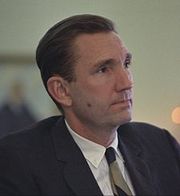
Clark, who turns 80 later this year, has spent half his lifetime in the political wilderness. Yet in 1967 he was government's Golden Boy. He was the son of U.S. Supreme Court Justice Tom Clark, and was appointed as Attorney General by President Lyndon Johnson.
He didn't change. America changed. Ramsey Clark in 1967 represented what those who followed the FDR Thesis of Unity considered attractive ideals -- civil rights, civil liberties, an expansion of American exceptionalism. These ideas were roundly rejected by American voters in 1968, who came to equate civil rights with black crime, and civil liberties with hippie-dom. Clark did not help himself with these people when he rejected the Vietnam War.
Yet it all seemed so right at the time. A generation later American liberals still look back to that moment and ask, what went wrong? We were so close to really changing things. All our stands were popular. Being against Vietnam was popular. Being against racism was popular. The Beatles were popular.
What went wrong is that, in all these areas, American liberals went ahead of where businesses wished to go. Business supported the Cold War, because the Cold War supported them. Businesses prized elitism over egalitarianism, and demanded that institutions be protected, not attacked.
So enough with the hints. Do you have your answer ready?
Following is the essay you can designate as Volume 10, Number 25 of
This Week's Clue, based on the e-mail newsletter I have produced since
March, 1997. It would be the issue of June 18.
Enjoy.
Orson Scott Card's Ender's Game, like Isaac Asimov's Foundation, is an early work which became a career and a classic.
Its protagonist is Ender Wiggin, trained without his knowledge to helm a life-and-death struggle between humanity and another race, far away. But its biggest innovations were Locke and Demosthenes, actually Ender's own siblings, whose online writings manipulate the world's leaders through the war and beyond it.
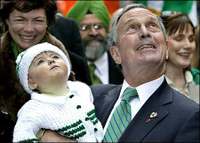
There is a lot of blogospheric excitement about New York Mayor Michael Bloomberg becoming an independent.
There is practically an on-air orgasm going on over at MSNBC, which believes he has completely scrambled the 2008 Presidential race and given hope to the Republicans.
The truth is the opposite. Bloomberg, if he runs, clarifies the race. And he guarantees victory to the Democratic nominee.
That's because, as regular readers of this blog will recall, Bloomberg is George Wallace. He is in revolt against the social policies of the dominant party, just as Wallace was in revolt against the Democrats' embrace of civil rights. And his Vice Presidential running mate, presumably conservative Republican Chuck Hagel, is (outside of Iraq) very much in tune with the party's social base, just as Wallace's sidekick, former General Curtis LeMay, was a big-time Cold Warrior. (Those who have seen Robert McNamara's The Fog of War will know that LeMay's memory was practically a co-star.)
There is only one group of Democrats who might be tempted at all by a Bloomberg candidacy, and these are the fans of Joe Lieberman, a rapidly-dwindling band indeed. Such corporatist, Cold War Democrats would have been a target of choice for any Republican anyway -- losing them to an independent instead is actually an advantage.
And, no, Bloomberg can't be elected. The best independent run ever was that of Theodore Roosevelt. He finished second. Ross Perot's 19% of the 1992 vote is the second-best independent result. But it was Wallace's 1968 result which had the most lasting impact.
The fact is we're rapidly moving toward an elite consensus on Iraq. Republicans like Fred Thompson are becoming more defensive, Democrats like John Edwards are becoming more accepting. Both sides are probably willing to accept a force of 50,000 or so, left indefinitely, so long as they're kept in forts and casualties are kept to a minimum. Activists drive the parties apart on the politics, but elites are coming together on the policy.
The economy is something else. While it's impossible to hide coffins with happy talk, thus most voters understand the reality of Iraq, the real estate recession has been hidden until now, because all the analysts on CNBC and everywhere else are part of the business -- they're all selling the idea of continued prosperity. None of them will tell you the truth if that truth is as nasty as this truth is.
Even the statements of Bill Gross, above, are a rosy scenario. He's talking about the government cutting interest rates so that the fall in housing prices is limited. But how do you cut interest rates when the dollar has already fallen through what you thought was the floor?
The housing market has become a falling knife. Higher mortgage rates, rising loan requirements, and increasing inventory means capitulation is ahead. Instead of a gentle fall in prices, you get an enormous kerplunk as desperate sellers take whatever offer they can. The whole equity base must then re-adjust to the new market reality, which means the problems you have in dicey loans are extended to anyone who bought high.
I have predicted 9 of the last 3 recessions, so perhaps you're going to want to discount what I say. I predicted the recession would start a year ago when the new bankruptcy laws kicked in. It didn't. That's because the recession process is tied to real estate, which moves very slowly, even glacially, and the bankruptcy law only caused real estate to start moving. It has taken this long for the movement to become obvious.
The following is a work of fiction. Here is the Table of Contents, which is updated as new chapters are written.
It is the third in a series of sci-fi novels of the type known as
alternate history. What's different is that this series takes place in
our time, with characters familiar in your real life.
One reason why, at 52, I sometimes write like an impatient teenager has to do with technology's myth of adult supervision.
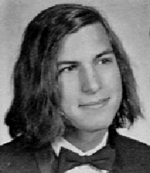
When I started writing about tech, in the 1980s, it was assumed that young entrepreneurs needed someone more seasoned at the helm, or their companies could not be taken seriously. So Microsoft took on a collection of gray-haired old farts, as did Apple, and Apple's old fart tossed Steve Jobs (left) out on his ear.
We know how that worked out, but these clowns were still doing it in the 1990s, when Yahoo burst on the scene. They demanded Jerry Yang and David Filo get some "adult supervision," which they did.
Once again, it didn't work out. Tim Koogle (the story on that link tells everything) and Terry Semel have been failures at the helm of Yahoo. I would assert the only reason Eric Schmidt hasn't mucked-up Google is that he is mainly a figurehead -- founders Larry Page and Sergey Brin still retain a measure of control. (Please remember the great job Schmidt did at Novell.)
When magazines like Business Week claim that young entrepreneurs should give up control of their companies, they're speaking for old farts who want to steal them.
I want to revisit one of our 1966 Game Pieces in light of current events and an important political trend.
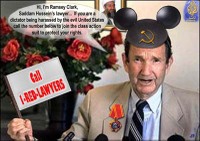
A year ago I compared Ramsey Clark to Alberto Gonzalez. I noted that he was following the Lyndon Johnson-Harry Truman-Franklin Roosevelt "Thesis of Unity" to its extreme end, and in so doing destroying the coalition he sought to represent.
Politically, Clark became a catalyst. He helped convince Middle America and (perhaps more important) American business that Democrats could not be trusted. His focus on the rights of poor people, and his evolving opposition to the Cold War Activity which was Vietnam, convinced businesspeople that they had no choice but to move, ever-more solidly, to the Republican Party.
Fuel cells that cost much less to make and to run.
The problem with fuel cells, in a word, is platinum. Not only do you need platinum to make a fuel cell that will power a car, but the platinum tends to wear out. Platinum is also very expensive.
The breakthroughs we're seeing today come along two tracks:
Microfabrication, the use of techniques from computer chip production into fuel cells, lowers costs directly, while also enabling breakthroughs in the width (and thus size) of practical fuel cells. We're talking here of fuel cells replacing batteries.
Recent Comments